








Blog
Jackie the Eagle Update: Critical but Fighting at Ojai Raptor Center

Nature is as brutal as it is beautiful. For millions of viewers worldwide, the daily lives of Jackie and Shadow—the famous bald eagle couple of Big Bear Valley, California—offer a serene escape into the wild. However, the tranquility of the nest was shattered when a fierce territorial dispute left Jackie grounded and fighting for her life.
Late last week, Jackie was spotted near the shoreline of Dana Point Park on the northwest side of Big Bear Lake. According to the Friends of Big Bear Valley (FOBBV), the matriarch was defending her territory against two subadult bald eagles. While Jackie successfully drove the intruders away and protected her home, the altercation left her physically compromised and entirely unable to fly.
For a wild raptor, being grounded is an immediate death sentence without human intervention. Fortunately, local authorities and dedicated wildlife rescue teams mobilized quickly to secure the beloved bird.
A Coordinated Emergency Rescue
The rescue operation was a testament to the community’s dedication to its local wildlife. Local emergency response teams sprang into action on Friday night after Big Bear firefighters were alerted to a grounded eagle. Recognizing the severity of the situation, officials from the Los Angeles County Parks and Recreation Department stepped in to safely capture her.
Because Jackie was severely weakened from her ordeal, the capture took only about five minutes. Firefighters monitored the eagle until LA County Parks staff could safely transport her to the San Dimas Raptor Rescue for an initial emergency evaluation.
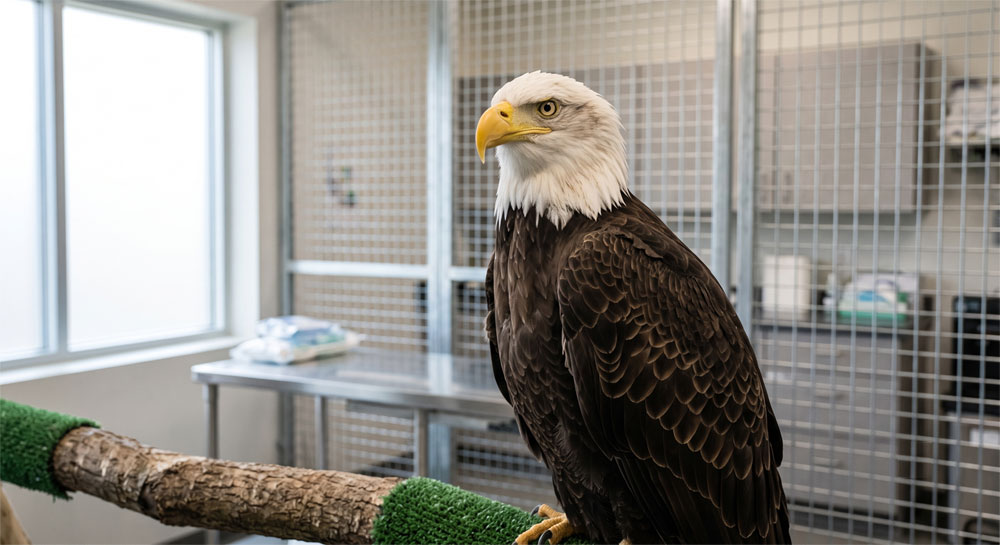
While San Dimas provided critical stabilization, bald eagles require highly specialized, long-term medical care. Consequently, she was transferred to the Ojai Raptor Center in Ventura County, a premier facility fully licensed and equipped to handle the intensive rehabilitation of large birds of prey. Admitted as Patient 26-519, Jackie’s fight for survival entered a new, highly clinical phase.
Medical Evaluation: Severe Anemia and Kidney Inflammation
Upon arrival at the Ojai Raptor Center, a team of specialized avian veterinarians immediately began a comprehensive medical assessment. The initial findings painted a deeply concerning picture.
Recent bloodwork tests revealed that Jackie is suffering from severe anemia and inflammation affecting her kidneys. At the time of her rescue, officials noted that she did not appear to have major visible physical injuries from the territorial fight, but she was noticeably skinny, underweight, and “very sick”.
The Ojai Raptor Center released an update confirming that her condition remains critical. The exact underlying cause of her sudden illness is still undetermined, and veterinarians are currently awaiting the results of advanced diagnostic tests. Given the symptoms, experts are looking into potential environmental toxins, such as lead poisoning or rodenticides, which are unfortunately common hazards for wild raptors.
Despite the grim diagnosis, there are glimmers of hope. Jackie is currently alert, sitting up, and eating on her own. The veterinary team has initiated supportive medical treatments based on the preliminary test results, and they are consulting with wildlife professionals from around the world to formulate the best possible care plan.
Understanding the Threats: Why Eagles Get Grounded
While Jackie’s immediate grounding was triggered by a physical altercation with two subadult eagles, her underlying health issues paint a more complex picture of the threats facing modern raptors. Eagles are incredibly resilient creatures; a healthy adult can usually recover from minor territorial skirmishes. The fact that Jackie was found severely underweight and suffering from internal inflammation suggests she was already battling a systemic issue before the fight occurred.
Avian experts often point to two primary culprits when treating eagles with these symptoms: lead toxicity and anticoagulant rodenticides. Lead poisoning frequently occurs when eagles scavenge on animal carcasses left behind by hunters using lead ammunition. Even a microscopic fragment of ingested lead can shut down a raptor’s digestive and neurological systems, leading to severe anemia. Similarly, rat poisons work their way up the food chain. When an eagle consumes a rodent that has ingested bait, the eagle suffers secondary poisoning, which causes internal bleeding and organ failure.
While the Ojai Raptor Center has not yet confirmed toxicity as the definitive cause, they are running extensive diagnostic panels to rule it out. Understanding the exact cause of her weakened state is vital not only for her immediate treatment plan but also for the broader conservation efforts in the Big Bear region. If environmental toxins are identified, it can prompt local wildlife agencies to investigate and mitigate the source, thereby protecting Shadow and the rest of the local raptor population.
Shadow Holds the Fort: Life at the Nest
One of the most heart-wrenching aspects of this story for loyal Eagle Cam viewers is the current situation back at the nest in Big Bear Valley. Bald eagles mate for life and share domestic duties equally. With Jackie absent, the entire burden of parenthood and territorial defense has fallen onto her loyal mate, Shadow.
The couple successfully hatched two eaglets this season, affectionately named Sandy and Luna by their global fanbase. Shadow has stepped up to the challenge admirably. The Friends of Big Bear Valley confirmed that Shadow is acting as an excellent father, continuing to feed the young eaglets while aggressively protecting the nest and their surrounding territory.
Shadow’s resilience ensures that Jackie’s genetic legacy continues to thrive, even as she battles her own health crisis miles away in a clinical setting. The survival of Sandy and Luna is a massive comfort to the researchers and fans who have invested years observing this avian family.
The Importance of Wildlife Rehabilitation
Jackie’s ordeal highlights the critical role that wildlife rehabilitation centers play in preserving apex predators. Bald eagles, once on the brink of extinction due to the pesticide DDT, have made a triumphant return across North America. However, they still face significant modern threats, including habitat encroachment, territorial disputes driven by limited resources, and secondary poisoning.
Facilities like the Ojai Raptor Center operate largely on public donations and the tireless work of trained volunteers. Treating a large raptor in critical condition is incredibly resource-intensive. From running specialized blood panels to providing around-the-clock supportive care and a highly specific diet, the financial and logistical demands are immense.
The fact that Jackie is receiving this level of care—often described as the “best of the best” by wildlife officials—is a direct result of public awareness and funding. Her case serves as a powerful educational tool, bringing the realities of wildlife conservation directly into the homes of millions of internet viewers.
A Global Outpouring of Support
The news of Jackie’s critical condition has sent shockwaves through the massive community of bird watchers, nature enthusiasts, and casual viewers who follow the Big Bear Eagle Cam. Social media platforms have been flooded with messages of support, prayers, and deep concern for the eagle’s recovery.
The Friends of Big Bear Valley have expressed immense gratitude for the outpouring of love, reassuring the community that Jackie is a strong bird. The Ojai Raptor Center has also felt the wave of public support, utilizing the attention to raise awareness about their Bald Eagle Recovery Campaign, which funds the care of eagles, hawks, owls, and hundreds of other wildlife patients they see each year.
This global connection proves that digital nature observation is more than just passive entertainment; it fosters a deep, empathetic connection to the natural world. People who have never visited California feel a personal stake in the survival of a single wild bird.
What’s Next for Big Bear’s Famous Matriarch?
At this stage, Jackie’s long-term prognosis remains uncertain. Wildlife medicine is highly unpredictable, and the stress of captivity combined with severe internal illness makes her recovery a delicate, day-by-day process.
The immediate next steps involve stabilizing her red blood cell count, managing the kidney inflammation, and identifying the root cause of her ailment through the pending lab results. If she can overcome the acute phase of her illness, she will face a long road of physical rehabilitation to rebuild her flight muscles before any potential release back into the wild.
For now, the world watches and waits. Shadow continues his lonely vigil high up in the Big Bear pines, raising Sandy and Luna. Meanwhile, miles away in Ventura County, Patient 26-519 is proving why she earned the title of matriarch. Jackie is fighting, and she is not doing it alone.